
Research Update #1
What's an Aircraft Action Report?

Thanks to your support this month, I was able to cover the costs of the following:
Yearly membership at U.S. Naval Institute (gives me access to Proceedings): $45
Yearly membership at Yorktown Association: $50
Subscription to Adobe: $20 a month
Quarterly subscription to Grammarly: $60
A copy of “The Odyssey of Fighting Two”: $120
A copy of “Japanese Naval Aces and Fighter Units in World War II”: $10
A copy of “The Jolly Rodgers: The Story of Tom Blackburn and Navy Fighting Squadron VF-17”: $11
A copy of Collier’s magazine dated June 10, 1944 (has a very useful article on a Hellcat pilot): $38
Monthly subscription on JSTOR: $20
If you’ve been getting value out of these updates, and aren’t already, consider becoming a paid subscriber or passing this along to someone who might. Every bit helps me acquire more primary, secondary, and other sources!
Anyone who spends time in the writing about carrier fighter pilots in WWII eventually runs into the same abbreviation: ACA. This stands for Aircraft Action Report, and it is arguably the single most valuable class of document for reconstructing what actually happened in the air over the Pacific. Since much of the research behind this book runs through these reports, it seemed worth pausing to explain what they are, how they were built, and what they can and cannot tell a historian, using one report in particular as a guide.
An Aircraft Action Report was generated on a standardized Navy form, ACA-1, filled out by a squadron’s Air Combat Intelligence Officer (or ACIO) after a mission that involved contact with the enemy. The form was not really a personal narrative but really a structured intelligence instrument, broken into numbered sections that moved from the mechanical facts of a mission toward the more interpretive tactical judgments that command wanted extracted from it.
The report used as the example here is a copy I recently received from the National Archives. Fighting Squadron 17’s Report No. 21, flying F4U Corsairs covering the squadron’s cover of Task Force 50.3 on November 10 and 11, 1943, during the carrier strike on Rabaul, is approximately 13 pages. While I am primarily writing about Hellcats, I got this report directly from archivists at the Archives in College Park (who are extremely good at their jobs and should have a budget of $100 billion), and it is not on their digital catalog, so you’re actually getting exclusive content!1
The report opens with General information: the reporting unit, VF-17; its base, Ondongo; the mission, covering Task Force 50.3, built around the Essex-class carriers Bunker Hill, Essex, and light carrier Independence and their destroyer screen; and the takeoff and return times recorded in Greenwich Civil Time, the standard reference used across the fleet to keep multiple units and time zones synchronized in a single report. This particular report carries a small but telling wrinkle common to Pacific documents from this period. The date of action is given as November 10, but several of the actions described, including landings and a Higgins boat rescue, fall in the early morning hours that would have been November 11 by local time in the theater. The GCT convention explains the discrepancy.
From there, the form catalogs the aircraft. Section II lists VF-17’s own F4U-1 Corsairs, twenty-four sorties in all. Section III lists the other American and Allied aircraft in the same operation, in this case Hellcats from VF-33, VF-18, VF-9, and VF-22, flying off Segi and off the three carriers. Section IV turns to the enemy, cataloging the Japanese aircraft encountered by type, using the Allied reporting names of the day: Tony, Hamp, Zeke, Val, Kate, Betty. The report estimates fifty to sixty Zekes, Tonys, and Hamps, and forty to fifty Vals and Kates, arriving in coordinated waves against the task force, along with the weather and visibility conditions the pilots were fighting through at the same time, described here as solid overcast at twenty-four thousand feet with heavy squalls on three sides of the formation.
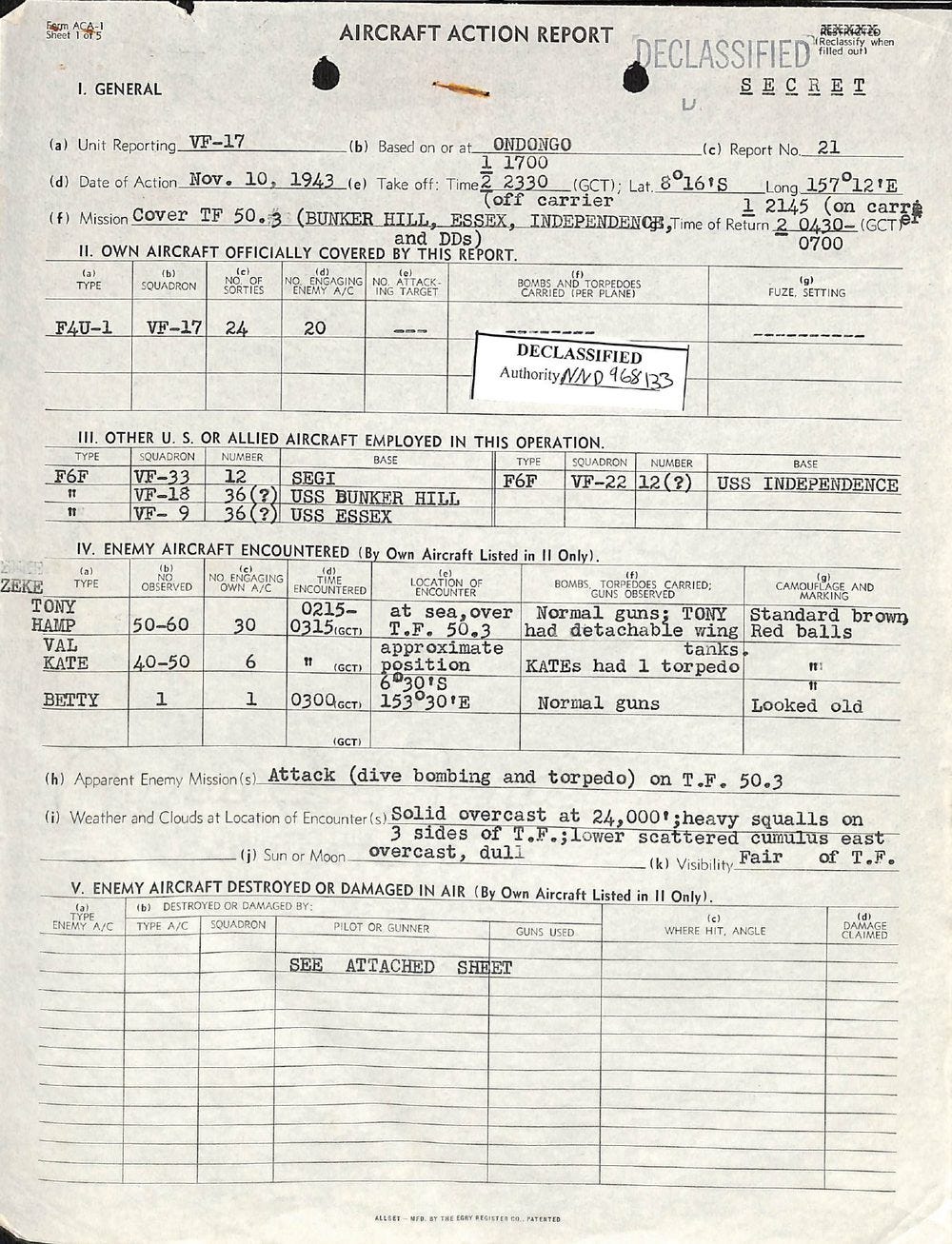
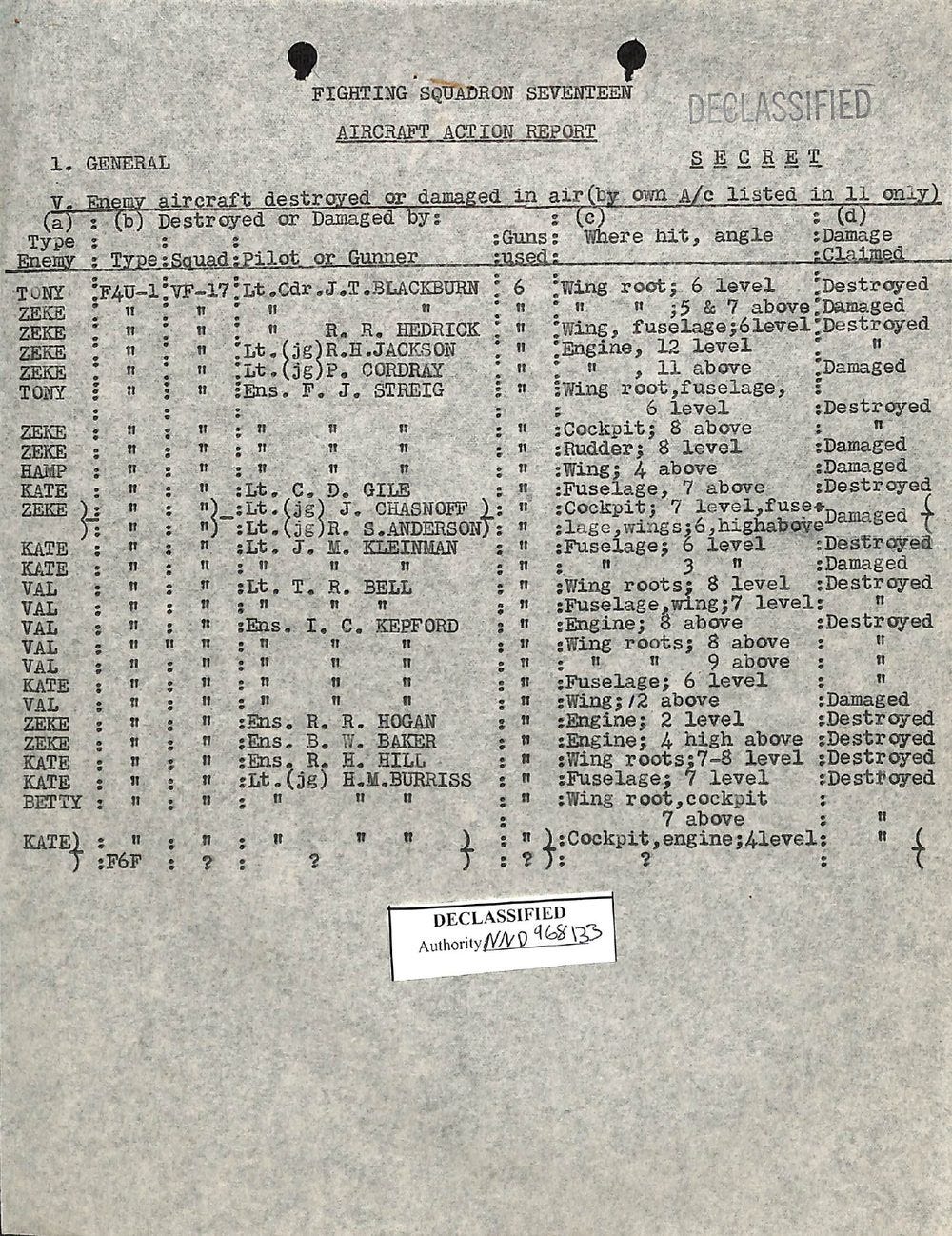
Then comes the section most historians go looking for first: Section V, enemy aircraft destroyed or damaged in the air, which for this report runs to a full attached sheet. It credits individual pilots by name, the type of enemy aircraft claimed, the guns used, where the aircraft was hit, and the result, destroyed or damaged. Lieutenant Commander John “Tommy” Blackburn is credited with a Tony destroyed and a Zeke damaged. Ensign Ira Kepford appears four times, credited with four Vals in a single engagement. Ensign Francis Streig is credited with two Tonys destroyed along with Zekes and a Hamp damaged. These claims sheets are exactly the kind of American victory count that later has to be checked, where possible, against surviving Japanese loss records, since aerial claims from every air force in every theater of the war were almost always exaggerated. As Jonathon Parshall and Anthony Tully put it, aviators “were prone to seeing what they wanted to see.”2 Luckily American planes had gun cameras that were activated every time an aviator pulled the trigger recording both video and photos so some auditing could be done. But the cameras could be prone to malfunction but were a useful tool nonetheless.
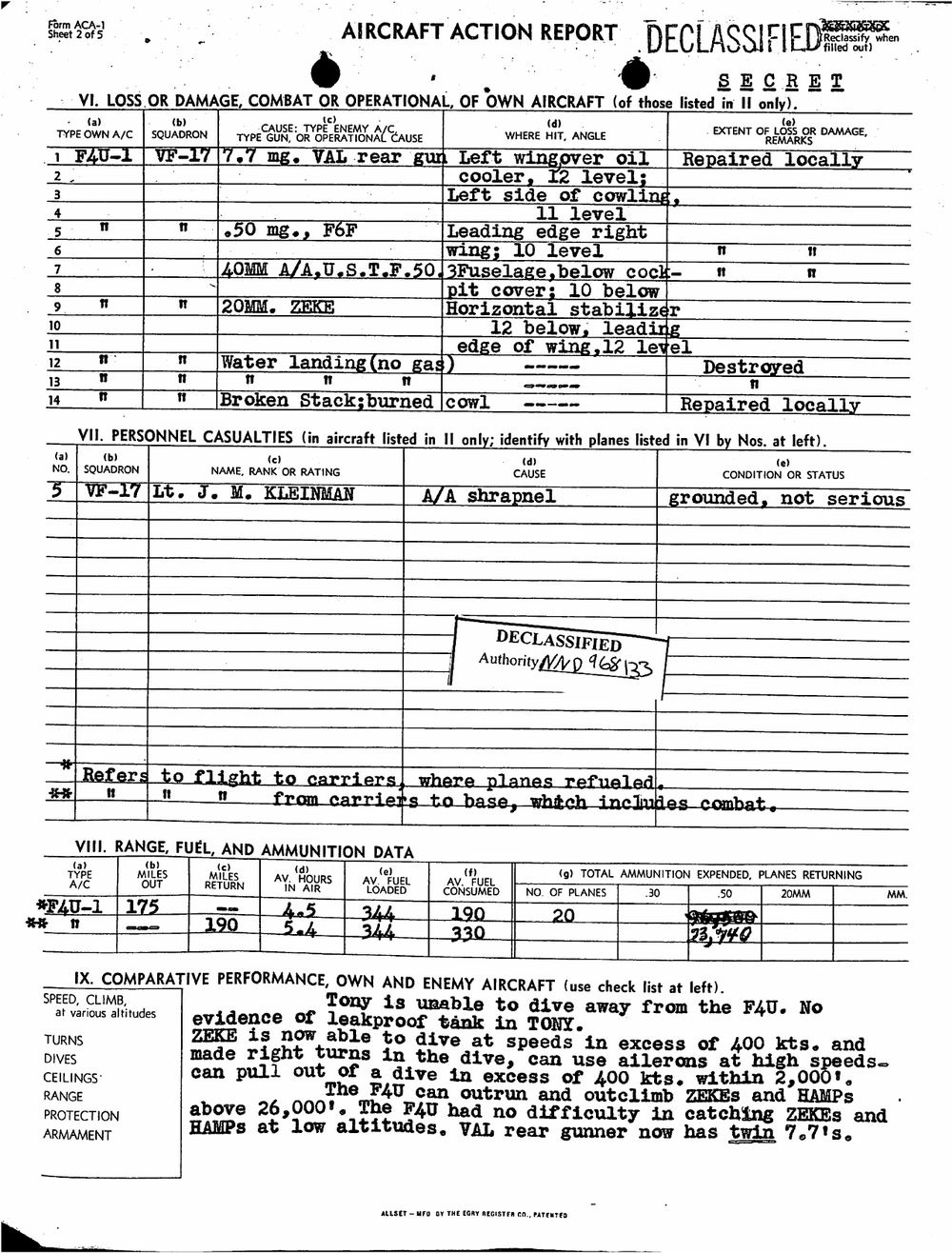
The following sections track the cost on the American side. Section VI records damage to VF-17’s own aircraft, including one Corsair lost to a water landing after running out of fuel and one pilot, Lieutenant J. M. Kleinman, wounded by anti-aircraft shrapnel that blew up his instrument panel, a wound recorded in Section VII with the almost clinical understatement typical of these forms: grounded, not serious. Section VIII tabulates range, fuel consumed, and ammunition expended across the squadron, numbers that read as dry data until you register that some of these Corsairs were in the air for five hours and landed with fifteen gallons of gas remaining. Section IX closes the sheet with a comparative performance note on American and Japanese aircraft, in this case an early observation that the Corsair could now outdive and outclimb the Zeke and Hamp above twenty-six thousand feet, and that the Val’s rear gunner had apparently been upgraded to twin machine guns.
For the narrative historian, the heart of any Aircraft Action Report lies in Section XII, Tactical and Operational Data, the portion of the form where the squadron’s ACIO was given license to depart from tabular summary and write a running prose account of the engagement. The quality and texture of these accounts varied enormously from squadron to squadron, and even from action to action within the same squadron’s file. Some ACIOs, evidently working from thorough post-flight debriefs and perhaps a personal instinct for storytelling, produced accounts that traced the experience of nearly every pilot who had flown, division by division and sometimes plane by plane, preserving details of altitude, heading, and split-second decisions that would otherwise have vanished with the men who made them. Others were content with a high-level summary of the strike as a whole, a paragraph or two noting the general shape of the action without descending into individual detail. The difference seems to have depended less on any fixed Navy standard than on the particular ACIO assigned to the squadron and on the squadron commander’s own expectations of what the report should say; a reminder that even a standardized form could only go as far as its writers would take it.
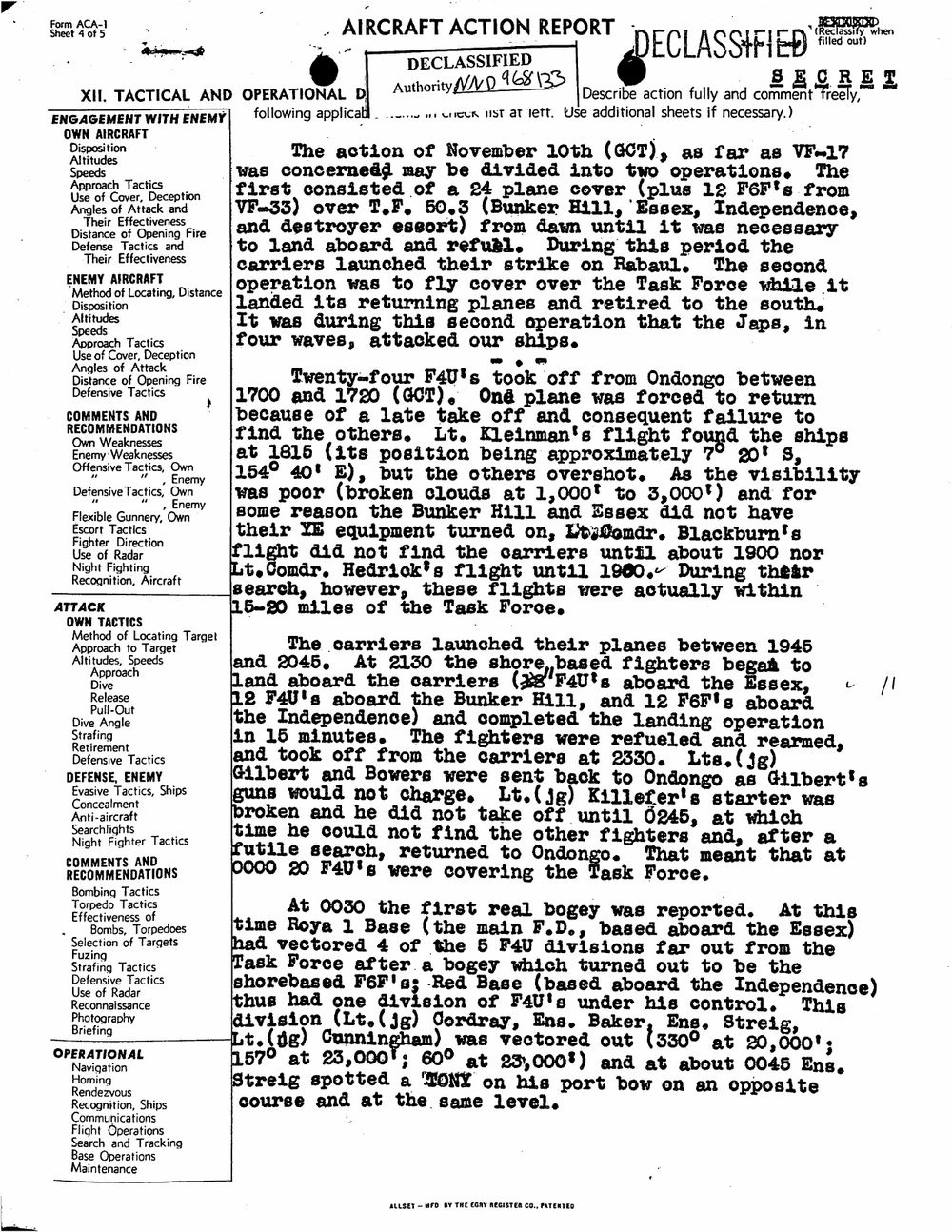
Streig chasing a Tony in a dive, overtaking it, and firing from three hundred yards astern until it exploded; Kepford peeling off from Bell to work through a formation of Vals in a rain squall; Ensign Robert Hill nursing a dying engine down to a water landing off Sterling Island, inflating his life jacket, and eventually being picked up by a Higgins boat after a shore battery manned by some New Zealanders spotted him.
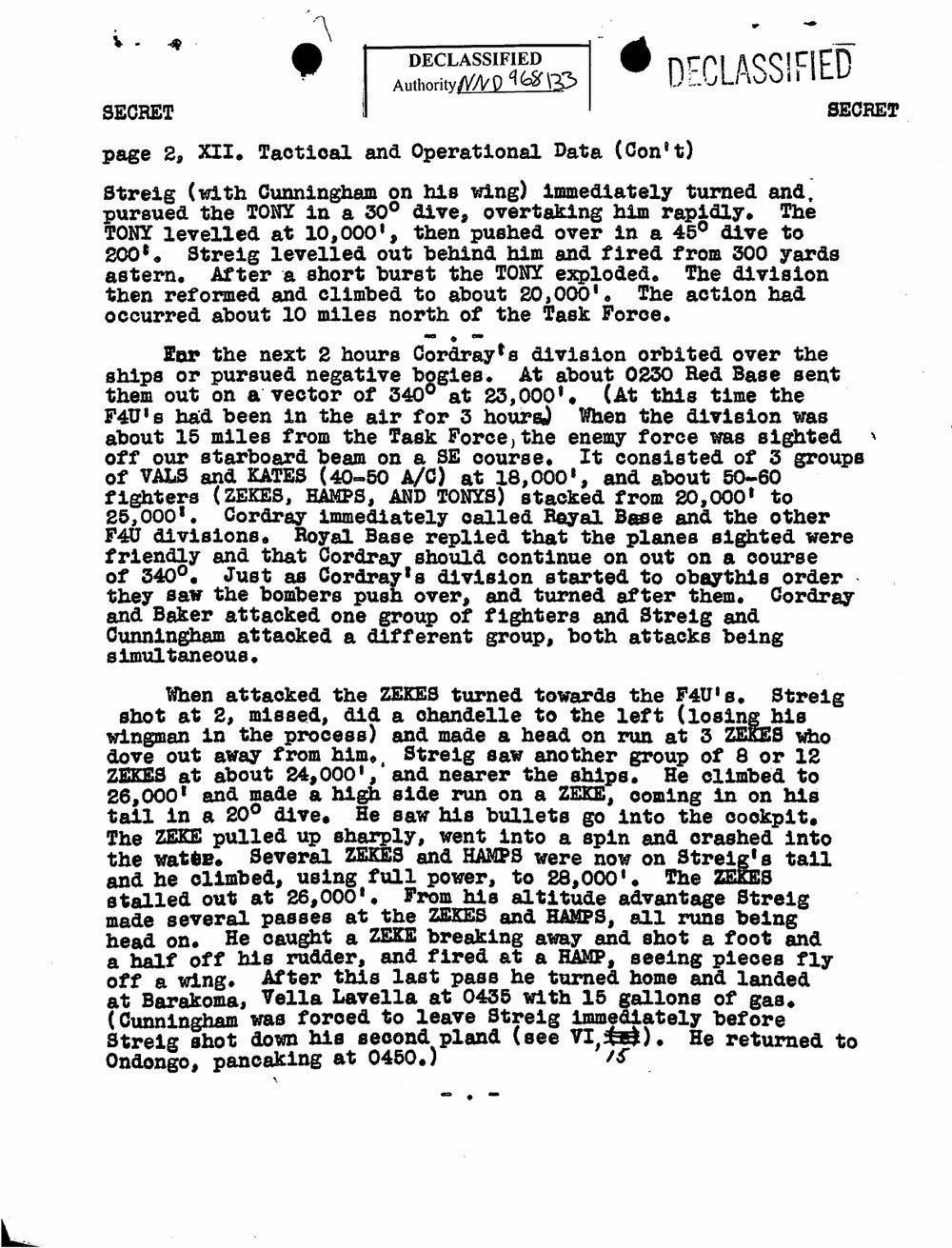
The section closes with the ACIO’s own tactical commentary. He laid the near disaster of that night squarely on a failure by the fighter director aboard Essex, who vectored the covering fighters thirty miles from the task force chasing a contact that turned out to be friendly, and only recalled them once the attack was already underway. Had the Independence’s fighter director controlled all five divisions instead of just one, the report argues, thirty-two fighters could have met the Japanese strike before it reached the ships, rather than the handful that actually did.
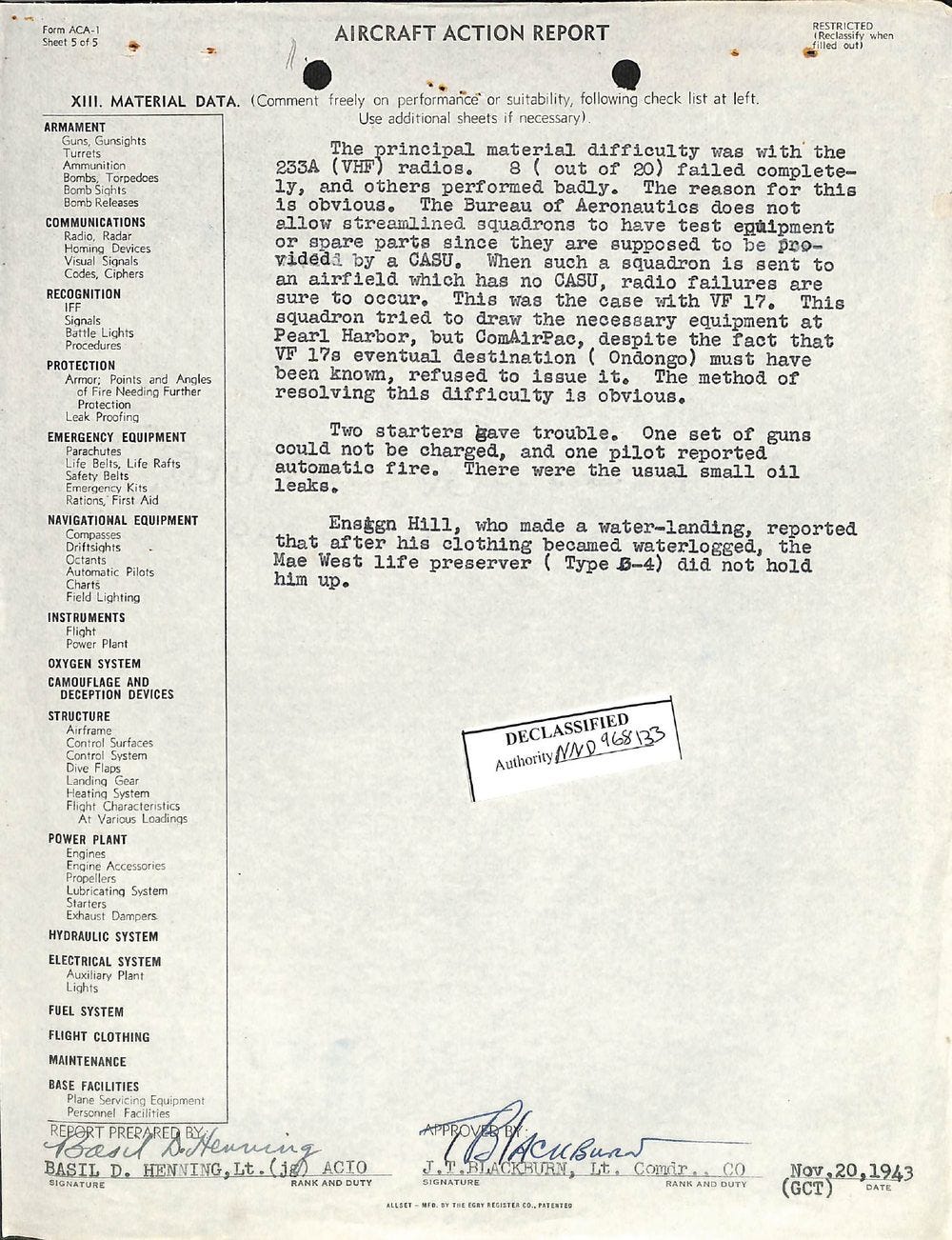
Finally, Section XIII, Material Data, records the mundane but operationally critical stuff: eight of twenty VHF radios failed outright, a problem the report traces to a supply bureaucracy that assumed a shore-based squadron would have equipment provided by a Combat Air Service Unit that VF-17, newly arrived at Ondongo, did not have. Reports like this one were signed off by the squadron’s ACIO, in this case Lieutenant Basil Henning, and approved by the commanding officer, Blackburn himself, whose signature closes the report on November 20, 1943, ten days after the action it describes.
What makes the ACA valuable to a historian is its structure. Because every squadron filled out the same numbered sections in the same order, reports can be compared across squadrons and across years in ways a diary or a memoir cannot. A claim in Section V can be checked against a fuel and ammunition figure in Section VIII, against a narrative detail in Section XII, and eventually against a Japanese report describing the same afternoon from the other direction. The form’s rigidity, which came out of a wartime bureaucracy trying to extract usable intelligence from men who had just landed after five hours in the air and a fight for their lives, is what makes it possible, eight decades later, to reconstruct what happened over Task Force 50.3 on November 11, 1943, almost minute by minute.
It is worth pausing on where all of this information actually came from. The tactical narrative in Section XII was not written by someone who watched the fight from a safe remove. It was assembled by an intelligence officer sitting across a table from pilots who had, in some cases, been in the air for five hours, flown through anti-aircraft fire from their own ships, and landed with fifteen or twenty gallons of gas left in the tank. The debrief happened in the hours right after the mission, while adrenaline was still running and before anyone had time to compare notes carefully against a stopwatch or a map. That context matters for how the claims in these reports should be read.
The report itself is honest about this. In the account of Cordray’s second run on a pair of Zekes, the ACIO records that Cordray got in a good burst and saw the enemy plane’s engine smoking, then lost sight of it in the confusion of the fight. The report does not claim a kill outright. It says the Zeke was probably destroyed, a phrasing that shows up more than once across these narratives and that a careful reader has to treat differently from a claim the pilot actually watched go into the water.
Aerial combat also produced claims that overlapped without anyone involved realizing it at the time. Later in the same fight, Lieutenant Gile picked up a Kate heading west and started after it, only for an F6F from another squadron to get there first. The ACIO recorded that detail because Gile reported it himself, but it is a small window into a much larger problem: in a swirling fight with dozens of American fighters converging on the same handful of enemy formations, more than one pilot could reasonably believe he had destroyed a given aircraft, and the paperwork trail does not always catch the duplication. Multiply that across every carrier task force and every raid of the war, and it becomes clear why the aggregate claims filed by all sides in the Pacific consistently ran ahead of the losses the other side’s own records eventually confirmed.
None of this means the reports are unreliable. It means they are testimony, taken under the worst possible conditions for careful observation, and testimony has to be weighed rather than simply transcribed. A pilot who watched an enemy aircraft’s wing catch fire and spin into the water at close range gave a different order of evidence than a pilot who fired a burst, saw smoke, and lost the target in a cloud. The ACIOs who compiled these reports generally preserved that distinction in their own language, using destroyed, damaged, and probably destroyed as genuinely different categories rather than synonyms. The responsible way to use a report like this one, then, is to carry its hedges forward rather than resolve them, and to treat the claims sheet in Section V as a record of what pilots believed they had done, checked wherever possible against the loss records the other side kept of its own.
Funny enough, according to VF-17’s CO, he had to do this report on a crappy portable typewriter after his attempt to steal one from the Bunker Hill was stopped by its executive officer after they were transferred (more on that story later).
Jonathan Parshall and Anthony Tully, Shattered Sword: The Untold Story of the Battle of Midway (Washington, DC: Potomac Books, 2005), 231.
So glad you are doing this work! I am reminded of both my parents however - my father Army Air Corps/later US Air Force when it was created he of course was automatically assigned to it. My mother was Civilian Air Patrol from 1948 onwards to the mid 1960’s.They were stationed on Cape Cod, then Kentucky and because of family housing shortages bought a 60’ house trailer which they drove from the east to Port Hueneme base where I was born in the mid-1950’s (no interstates then!) They lost many good friends who never came back from Korea. Somehow my father never got transferred there & continued as a Master Sgt aircraft mechanic on SAC. He eventually put in for more training & transferred to Biloxi, later to Springfield MA.
He was out of the service by the time I started school but the flight pattern for Brunswick Naval Air Station (ME) was directly over my 1st grade school & I was absolutely terrified when we had Air Raid drills ( as if crouching under our desks would have protected us!) especially if the jets had already flown over - or worse flew during the drill! I had overheard enough conversations while my father was in the service to know it wouldn’t matter, but was much to shy to voice my fears! I don’t think my older brother had any of those fears!
Anyway, thanks for the work you are doing, especially since so much of personnel records were destroyed & presumably others as well. Only about 5pgs of my father’s were were recoverable. My mother threw away everything he had after his death and I moved her with me. I do recognize some of your forms because my mother obtained her private pilot license & my father maintained her plane & one day caught a downdraft from very tall pine trees 🌲 at end of little runway my parents lived on with my brother & 2 grandchildren aboard. She & plane only injuries fortunately but lots of forms, FAA investigation of course. She was cleared but lots of forms, some similar to what you have.
Thanks again for your important work - have you been in touch with Museum in Rockland Maine? They are very helpful.